


There are many things that affect our early development. Another VERY important early developmental experience is the activities we do as kids. Particularly in utero through infancy.
Did you know that when you are an infant and can do nothing for yourself, the innate wisdom within you knows exactly what to do to build the capacity to be able to focus, have impulse control, have good attention, and have healthy emotional regulation, good sensory integration and learn about the world?
As we lie on our bellies, we hear things or see things out of the corner of our eye, and our curiosity pulls us to discover what that is. We attempt to lift our heads to see but there is no tone in our muscles yet, so we are unable to do so. But our curiosity keeps pulling us to discover what that sound or sight is. We keep efforting to lift our heads over and over until we have built enough tone in our muscles where we can actually lift our head and see what captured our curiosity.
And then something else catches our eye, or we hear something, and try to see but can’t because we have to push up to see more and we don’t yet have tone in our arm muscles. But our curiosity pulls us to effort, effort until we are able to push up and discover what that is.
This curiosity keeps pulling us through different developmental stages, crawling (on our bellies), creeping (on hands and knees), sitting up and eventually walking.
The thing is that each of these activities also build neuropathways in our brain for doing these activities. The early work of crawling and creeping are particularly important for building neuropathways for focus, impulse control, attention, math, reading, sensory integration and emotional regulation. Just to name a few.
Isn’t our innate wisdom just stunning!
Here are some symptoms that will tell you if you have some neurological damage or delay: difficulty naming sensations or emotions, difficulty with attention, poor impulse control, unable to stay focused (ADD, ADHD); difficulty with math or reading skills (Dyslexia), clumsiness, difficulty with reading social cues, Autism, Asperger’s, lack of empathy, sensory overwhelm, emotional dysregulation, behavioral problems.
In some cases, we may have had good early developmental activity completion but have had some experience that has damaged our neuropathways. For instance, really high fever, head injury, or even a small bump on the head, chemical exposure, mold exposure.
If we are not allowed to do our developmental activities that our innate wisdom takes us through, we will have lifelong issues.
Unfortunately, we have several generations that have neurodevelopmental deficits. Why? It became really popular to put kids in swings, walkers, jumpy seats or seats that prop them on their back. What?
You see when an infant is in one of these contraptions, they are not doing their developmental activities to build neuropathways in their brains. There has been an explosion of ADD, ADHD, Autism, Asperger’s, learning disabilities, sensory-motor problems, and behavioral problems. It has become an epidemic. Almost the norm (Normal just means everyone is doing or has the same thing. That does not mean it is healthy.)
There is a way to repair this.
In the late 1990’s early 2000’s, medical doctors finally figured out that there was a correlation between the devices keeping kids from their developmental activities and these problems. They began telling parents their kids need tummy time. Unfortunately, many parents think and hour a day of tummy time is enough. Tummy time should be an ongoing throughout the day. Kids need time to do their developmental activities. And they need time to develop healthy attachment.
Which means being picked up, gazed into their eyes, and interaction with their parents. This is why parenting is a lot of work. You are helping your child to develop healthy attachment, psychological and emotional health and well-being, and a stable healthy personality. It takes time and attention.
(Picture in stock: Smiling mother sitting with baby outdoors, with baby touching mother’s face
Many parents have relied on swings, walkers, jumpy seats to entertain kids and keep them out from under their feet so they get things done. Now they have added screens to the mix, so kids are having more attachment issues, don’t develop empathy, and aren’t’ able to understand social cues to have healthy relationships.
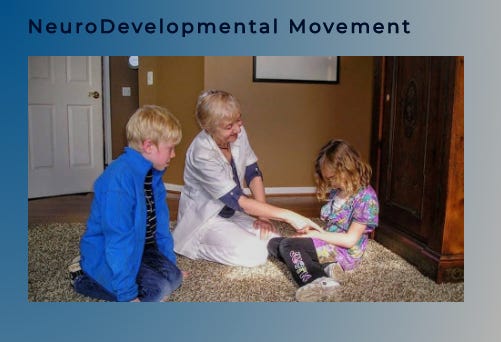
There are a group of practitioners called NeuroDevelopmental Movement Specialist who are able to assess how each part of the brain is working and then prescribe developmental movements to build new neuropathways. This means the symptoms resolve and people begin to have the ability to focus, control impulses, attend appropriately, have good emotional regulation, be able to handle sensory stimuli without being overwhelmed. I have even seen people either greatly improve or resolve their Dyslexia.
If you have one or more of these issues you have three options.
1. Manage the symptoms usually with medication and or behavioral interventions.
2. Resolve the issues with NeuroDevelopmental Movement
3. Do nothing and do the best you can to live with the issues.
It is important to understand that a neurologist will not pick up these issues. I have had clients who had one or more concussions and their neurologist told them they were done with treatment and their brain had healed. They were unable to do the reprocessing work on their trauma. When I sent them to Bette Lamont, https://www.neurodevelopmentalmovement.org, she found their brain injuries were not resolved. In the cases of the clients who did the NeuroDevelopmental work the issues were resolved, and they were able to return to reprocessing trauma.
Bette has worked with and entire community where all the kids were having behavioral problems, ADD, ADHD, sensory motor issues, etc. When she started working with one family, she discovered all of the parents were or had been using various contraptions that were keeping kids off their bellies. The parents of her clients told the other parents, and she was able to work with all of them.
Another note. Often adoptive parents discover over time that their adoptive kids are having developmental issues. Adoptive parents are often unable to really know the background of the child before the child came to live with them. There are overseas orphanages that keep kids strapped to their backs in their cribs for the first two years of their lives. So, the children have severe neurodevelopmental delays and severe attachment issues.
Why don’t the neurologists pick up the problems. They don’t have the training the DevelopmentalMovement Specialists do.
Bette Lamont sees clients in a number of states. You can visit her website at: https://www.neurodevelopmentalmovement.org.

You can also look for a practitioner at: https://neurosolutions-international.squarespace.com